

Your Dog’s Allergies Aren’t Getting Worse Because Of The Breed. They’re Getting Worse Because Nobody’s Treating What’s Actually Broken.
There’s a reason nothing your vet tries seems to hold for more than a few months — and it isn’t your vet, and it isn’t your dog.
7 reasons dog owners are going crazy over this liquid collagen · Trusted by 47,000+ dog owners
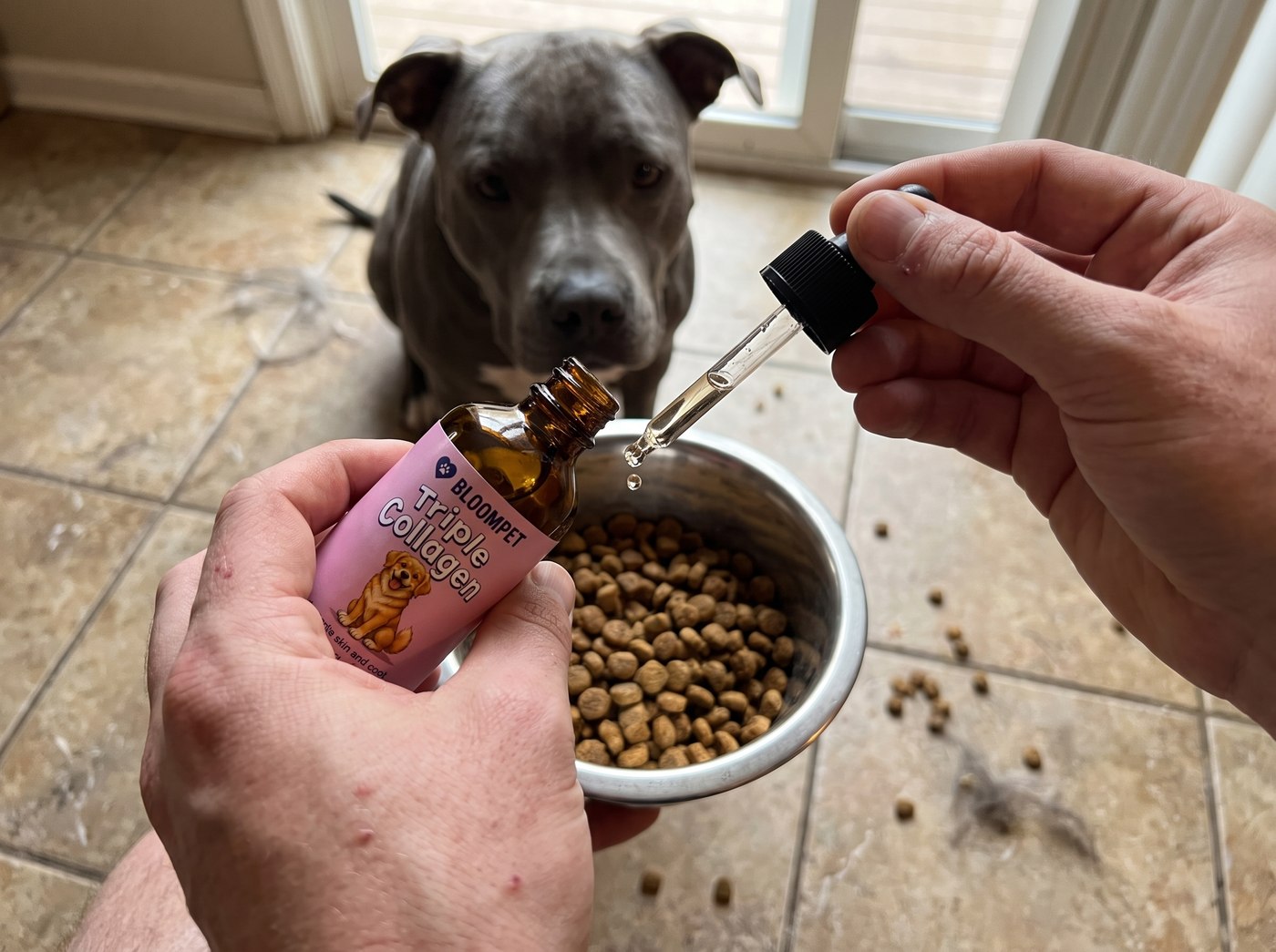
Keep the bottles.
Add it under what your vet prescribed.
No prescription needed.
No pills to hide, no diet change.
If you’re reading this at 2am with a dog scratching somewhere in the house, you already know the worst part isn’t the noise.
It’s that he looks miserable and you can’t help him. You’ve spent the money. You’ve done everything the vet asked. And he’s still chewing his paws raw while you lie there listening.
You’ve probably also heard, more than once, that some breeds are just prone to skin issues. That’s true. But it isn’t the whole story, and the part nobody finishes is the part that actually matters.
Start with the breed that comes to us more than any other.
“Red spots on belly and really itchy.” · “Red patches on her tummy.” · “Licking paws and belly constantly day and night.”
Bully breeds have thinner skin than most dogs — especially on the belly, the groin and the inner legs, from the underarms down. Which is exactly where you’ve been staring at red, raw skin for months or years.
The barrier that keeps allergens out lives in that skin. Thinner skin, weaker seal. So when she scratches — and she is going to scratch, that’s what allergies do — she’s tearing through something that was already fragile. Stuff gets in faster. Infections take hold quicker. That’s why the belly goes fire engine red, why the yeast comes back every few months, and why the ears never fully clear.
They also show up young. Most bully owners who come to us have a dog between two and four. The breed isn’t broken. The barrier is thinner.
Different breed? Everything below still applies — the barrier works the same way in every dog, and there’s a breakdown by breed further down. Bullies just start thinner, so it shows up sooner and harder.
Here are seven things nobody explained to us either.
Dogs Stop Scratching In Weeks Because It Rebuilds What’s Actually Broken
You know how Apoquel worked for 3 months then just… stopped? Or how Cytopoint used to last 6 weeks but now you’re getting shots every 2 weeks? Or Benadryl and Zyrtec did absolutely nothing?
Here’s why: Apoquel, Cytopoint and Zenrelia suppress the itch signal. That’s their job, and they genuinely do it. But none of them touch the barrier. The skin underneath is still torn, still thin, still letting everything through.
And in a dog whose barrier was already thinner — a bully breed, or any dog far enough into this — the drugs plateau faster. That’s why some dogs burn through Apoquel in a year when others stay on it for five. It’s not the drug failing. It’s the barrier underneath never getting repaired.
Your dog’s skin is a wall. Its only job is to keep allergens on the outside. Pollen, dust mites and yeast are supposed to sit on top of it doing nothing at all, and on a healthy dog that’s exactly what happens.
After age 2, dogs lose skin collagen every year. The seal thins. Gaps open. What used to sit harmlessly on top starts reaching the tissue underneath, and the immune system meets it.
Bloom closes those gaps. Liquid collagen rebuilds the barrier from inside. Allergens stop getting through. Most owners see the scratching drop between weeks 3 and 5.
No pills twice a day. No shots every 2 weeks. And you don’t stop the medication to try it, because it’s food and it goes on top of whatever they’re already eating.
Here’s Why Every Single Thing You Tried Worked For Two Weeks And Then Stopped
This is the pattern that breaks people, and almost nobody explains it.
New shampoo, two good weeks. New protein, two good weeks. New medication, a bit longer, then the window starts shrinking. Nineteen good days becomes fifteen becomes eleven.
You read that as “wrong product, try the next one.” Six times.
Six for six isn’t six near misses. It’s a pattern, and a pattern means a mechanism.
Here it is: any change you make briefly lowers the immune system’s workload. New food, new shampoo, new drug, any change at all. That’s your two good weeks, every time. Then the body settles into the new normal and the wall is exactly as thin as it was before.
You’ve been resetting a counter. Nothing has touched the wall.
Which is why weeks four and five matter more than the first two. Week four is where every food change you’ve ever done fell over. If you’re still ahead at week four, that’s the first thing in years that hasn’t followed the pattern.

The Ears, The Head Shaking And That Yeasty Smell Finally Stop Coming Back
You know that smell. The one that fills the whole room when they come in from outside. The ear infections every 3 to 4 weeks. The head shaking fifty times in a row. The vet visits for drops that work for 2 weeks and then it’s back again.
And those rust-brown stains between his toes aren’t dirt. They’re saliva, which means the licking has been going on for weeks before you noticed, usually at night while you were asleep.
Here’s the part nobody explains: that smell is yeast, and yeast lives on every dog on earth, including the ones that don’t smell of anything.
So the question was never how to get rid of it. It’s always there. The question is why it’s multiplying on your dog and not on your neighbour’s.
The answer is the barrier. When it thins, yeast stops being a harmless passenger and gets into the tissue, where it causes inflammation, which produces more oil, which is exactly what the yeast feeds on.
An ear canal is just skin, folded into a tube. Same structure, same barrier, in the warmest and worst-ventilated shape on the whole dog. That’s why it’s the first place a skin problem shows up, and why the drops keep working and the infection keeps coming back.
Shampoo removes what’s on the surface and within four or five days there’s a normal amount back. Drops clear what’s in the canal. Neither one reseals the lining.

The 3 AM Scratching Stops, And You Both Finally Sleep
Dogs don’t scratch at 3 AM to annoy you.
When they claw at their skin until you hear it across the house, when they lick their paws for 45 minutes straight, when they bolt through the room shaking their head fifty times in a row, it’s the only way they have of telling you.
And there’s a reason it’s always the middle of the night. Itch has a daily rhythm. Partly the body’s own anti-inflammatory cycle dropping off, partly temperature, and mostly that at 3 AM there is nothing else competing with the sensation.
Which is exactly why it’s unbearable for both of you at the same hour.
As the barrier rebuilds, less gets through. Less gets through, less to react to. Less to react to, and the nights get quiet.
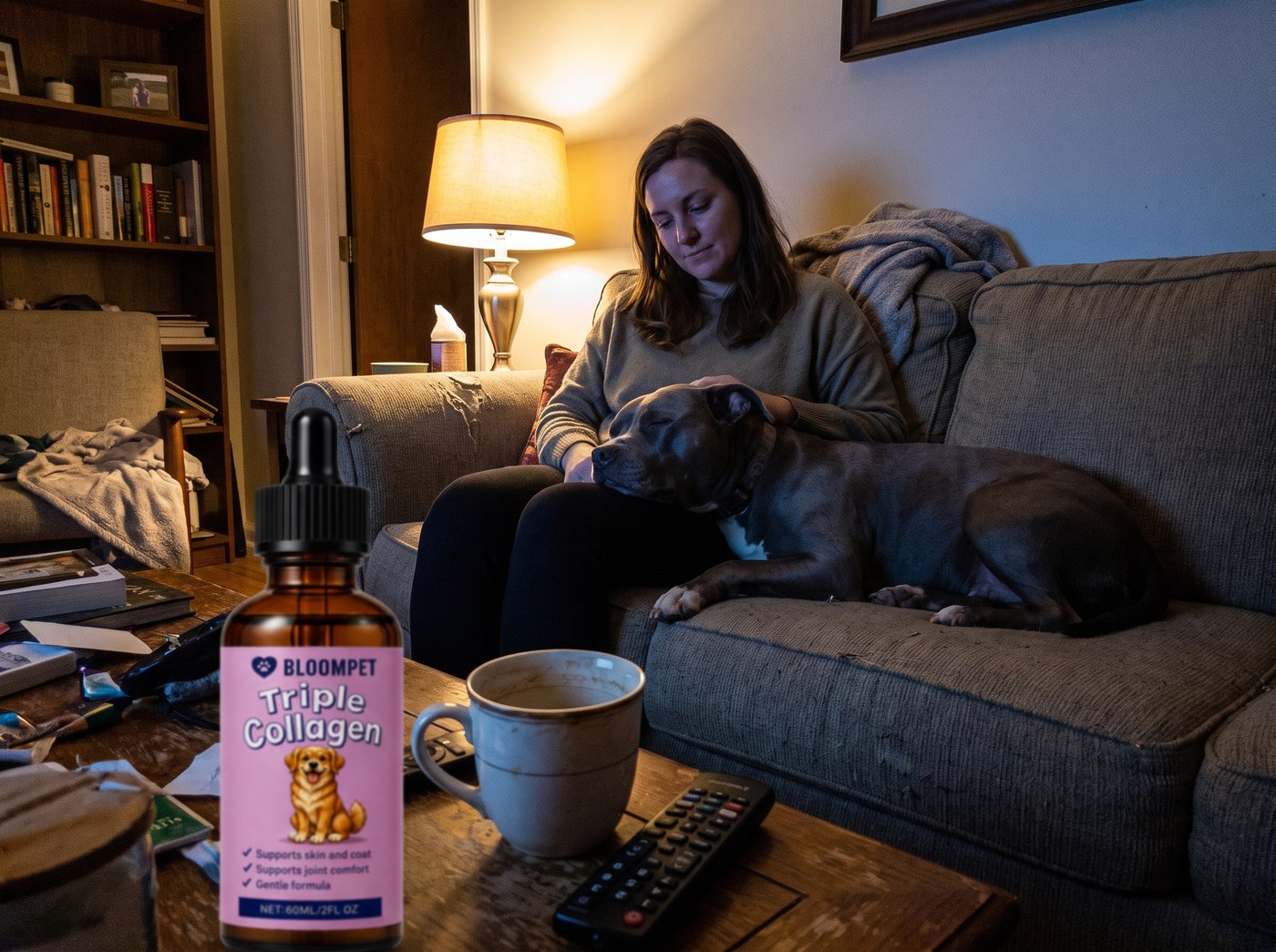
No more raw belly patches. No more pacing at 4am. A dog who actually rests instead of chewing himself bloody, and a house that sleeps.
Heat Destroys Collagen At 150°. Every Chew On The Market Is Baked At 300° Or Higher.
A lot of people tell us collagen doesn’t work for dogs. Almost all of them tried it once, from Amazon, and gave up. Here’s what happened to them, and it isn’t their fault.
Collagen chews are baked at double the temperature that destroys the peptides, so your dog gets the shell of it and none of the active. Powders mostly pass straight through. And most brands use Type II collagen, which is cartilage, a joint ingredient, and the cheapest thing to source.
So a lot of people gave a dog with a skin problem a joint supplement, watched nothing happen for six weeks, and reasonably concluded the whole idea was nonsense. That isn’t the same experiment.
Four things a collagen has to do at the same time, or it’s a waste of your money
- Cold-pressed, never baked. Above 150° the peptides are gone. Chews run 300°+.
- Liquid, not powder. Powders mostly pass through undigested.
- Three collagen types, including the skin ones. Type II on its own is cartilage — it belongs in a joint supplement, not a skin one.
- No chicken, beef or pork. Or you’ve undone the elimination diet you spent months on.
Most products manage one. The expensive ones manage two. Bloom is four for four — cold-pressed liquid, marine-sourced from deep-sea cod, three collagen types, plus hyaluronic acid to seal the barrier and lock moisture in, plus glucosamine to strengthen the structure underneath.
If you’ve already tried collagen and seen nothing, go and read the back of the tub. There’s a good chance it says Type II, and a very good chance it was baked.

Hot Spots Stop Forming And Fur Grows Back In The Bald Patches
Grain-free food, prescription kibble, fish oil, probiotics, medicated shampoos three times a week. And the hot spots still came back.
That’s because you were treating the reaction, not the barrier.
Coat is usually last to turn around, and there’s a reason: hair grows out of follicles that sit in the skin, so the skin underneath has to be calm before anything grows back through it. With one exception — and it depends on your dog’s breed.
Where it shows up first depends on your dog. We ask every customer what breed they have and what’s been going on, and the answers sort themselves into groups so cleanly it’s almost funny. Find yours — it tells you where to look. (Bully breeds, yours is at the top of this page.)
“He scratches his ear and body every day.” · “She has just started nibbling her paws and legs.” · “Scratches until she bleeds.”
The small breeds are the opposite story. Their owners almost never come to us with a young dog — the typical small-breed dog on Bloom is nine, ten, thirteen. Collagen loss compounds every year after age two, so in a small dog it often takes most of a decade before the barrier gets thin enough to give way. Then it goes quickly.
Skin folds and low ground clearance don’t help: folds hold moisture, and a chihuahua’s belly is four inches from whatever’s in the grass.
“Interrupted sleep. Ear infection.” · “Constant ear infections and scratching… heartbreaking to watch him stop mid play or walk to scratch.”
Double coats hide the problem. By the time you can see anything through that much hair it has usually been going on for months, which is why shepherd owners so often describe it as sudden — it wasn’t sudden, it was hidden. You tend to hear it or smell it before you ever see it.
Ears are almost always the first complaint in this group, and the night waking with it.
“Lots of paw pinkness & chewing.” · “Skin red, no more hair on his belly.” · “The itching and fur pulling.”
Retrievers present late and present at the paws. They’re also big enough and determined enough to do real damage fast — a lab that decides to chew a paw can take it from pink to raw inside a weekend, which is why this group ends up in the cone more than any other.
“He has been scratching all over non-stop, his ears smell like corn chips and he is noticeably uncomfortable. Has hot spots and yeasty paws.”
No history, no papers, and usually no idea what he was exposed to before you got him. The good news is that the barrier doesn’t need a pedigree — it works the same way in every dog, and you don’t need to know the breed to rebuild it.
Whatever your dog is, the order underneath tends to run like this as the barrier closes:
This is also why the guarantee is ninety days and not thirty. Ninety days is roughly how long a full barrier rebuild takes. We’d rather give you the whole window than sell you a bottle and hope.
Do this tonight, before it even arrives
Take one photo of the worst patch — belly, paws, wherever it is on your dog. Just one, in normal room light. Put it in a folder in your phone.
Then take the same photo on day 30.
You cannot judge “is he a bit better” from memory about a dog you look at all day. Almost everyone who tells us it didn’t work never had a photo to compare against.

Dogs Actually Eat It, And It Works Alongside Whatever They’re Already On
You know how you hide Apoquel pills in cheese and your dog spits them out? Or pill pockets you have to keep buying?
Bloom is a liquid you pour on their food. Dogs eat it with their regular meal. No fighting, no wasted pill pockets, no transition period. It goes on whatever’s already in the bowl.
One pour a day. Done.
And it works alongside whatever your dog is already on, because it’s food and there’s nothing for it to interact with. Keep them on what your vet prescribed and add this underneath it. Any change to a prescription is a conversation with your vet, on their timetable, not ours.
The two things people ask us before they order
We ask every customer what almost stopped them from buying. These are the answers that come up most.
“How do I know this isn’t another one that does nothing?”
Fair. You’ve been burned, and half the ads in your feed deserve the suspicion. So here is the guarantee written out mechanically, rather than as a badge:
- You have 90 days from delivery, not from purchase.
- Email support@bloompet.co. One email. You don’t need a reason, a photo, or a vet note.
- You do not ship anything back. Keep the bottles, even the empty ones.
- Refunded to the original card. Not store credit, not a discount code, not a partial.
If you ask for a refund and get offered a discount instead, reply with the word refund and it gets done.
“What if it just doesn’t work for my dog?”
Some dogs it doesn’t. We’d rather say that than pretend otherwise.
It does nothing for fleas, mange, or a food allergy you haven’t identified yet — those are different problems with different fixes, and a barrier supplement won’t touch them.
What it’s for is the dog whose skin keeps breaking down, who plateaus on every drug, and who has been through six things that each worked for two weeks. If that’s your dog and it still hasn’t landed by day 90, you get every penny back and you keep the bottles. That’s the whole risk.
Why people actually ordered
We also asked: what would have to happen for you to say this was worth it?
Nobody said “improved skin health.” They said this:
- “She stops scratching, paw licking, and the redness goes away”
- “I need to see the hot spots go away and his ears clear up”
- “No more head shaking and scratching”
- “Rawness gone, redness gone, scratching and kicking gone”
- “Clear skin and fur back”
- “Her being like when I first got her”
That’s the bar. Not a calmer dog. Not a slightly less itchy dog. Those are the six things to hold us to, and ninety days to decide whether we hit them.
What dog owners who tried everything are saying
“im at my wits end trying to find something that works. he scratches until hes raw and bleeding. Week 3 on Bloom and hot spots are healing. first time in years i have hope.”
“Tried grain-free food, chicken-free food, fish oil, probiotics, medicated baths 3x/week for 3 YEARS. Nothing worked. This is the first thing that actually FIXED it instead of just masking it. Week 10, still not scratching.”
“Being honest, she isn’t cured. She still has a scratch now and then and she still flares a bit in spring. But she’s maybe 70 percent better, she’s not chewing herself raw any more, and that’s more than the Apoquel ever managed long term. Took nearly 7 weeks though, not the 3 I was expecting.”
“She licks and licks and licks her paws. The fur is gone, theyre bleeding. Started Bloom, week 5 and the licking has almost stopped. I can finally pet her without feeling guilty.”
“Cytopoint shots every month that barely work anymore. Back to square one every time they wear off. Started Bloom. Week 8 and hes still not scratching.”
“Apoquel worked great for 6 months then just stopped. Vet doubled the dose. Worked 3 weeks then nothing. Added Cytopoint. Started Bloom alongside it. Week 8 her skin was clear and my vet was the one who suggested we try lowering the dose.”

Quick compare
| Bloom | Apoquel / Cytopoint | Chews & powders | |
|---|---|---|---|
| Rebuilds the barrier | ✓ Yes | ✕ Suppresses the signal | ✕ Usually Type II — joints, not skin |
| Survives processing | ✓ Cold-pressed liquid | — | ✕ Baked at 300°+ |
| Over time | ✓ Builds toward week 12 | ! Windows keep shortening | ✕ No change reported |
| Needs a prescription | ✓ No, it’s food | ✕ Yes | ✓ No |
| Form | ✓ Liquid, poured on food | ! Daily tablet or injection | ✕ Baked chew or powder |
Before you order
Can I keep him on Apoquel while he takes this?
Yes, and you should. Bloom is food — there’s nothing for it to interact with. Keep him on whatever your vet prescribed and add this underneath it. Any change to a prescription is a conversation with your vet, on their timetable.
How long before I know?
Some owners notice in the first week. Most see it between week 3 and week 5, and the guarantee runs 90 days because that’s roughly how long a full barrier rebuild takes. Take the photo tonight so you have something to compare against.
I have more than one dog. How much do I need?
Roughly a bottle a month per medium dog, less time than that for a big one. If you’re treating two or three, take that into account before you run out — several of our customers run a whole household on it.
Will he actually eat it?
It’s a liquid you pour over his normal food, so there’s no pill to hide in cheese and nothing to spit out. No transition period, no diet change. One pour a day on top of whatever’s already in the bowl.
What breeds is this for?
All of them — the barrier works the same way in every dog. Bully breeds start with thinner skin, so it tends to break down sooner and show up harder, but shepherds, labs, goldens, dachshunds, chihuahuas, beagles and shelter mixes make up most of the dogs using it.
You’ll know by week five. You have ninety days to decide.
Not a calmer dog. Not a slightly less itchy dog. The one you had before this started.
These statements have not been evaluated by the FDA. This product is not intended to diagnose, treat, cure, or prevent any disease. Bloom Triple Collagen is a food supplement, not a medication, and is not a substitute for veterinary care. Individual results vary from dog to dog.